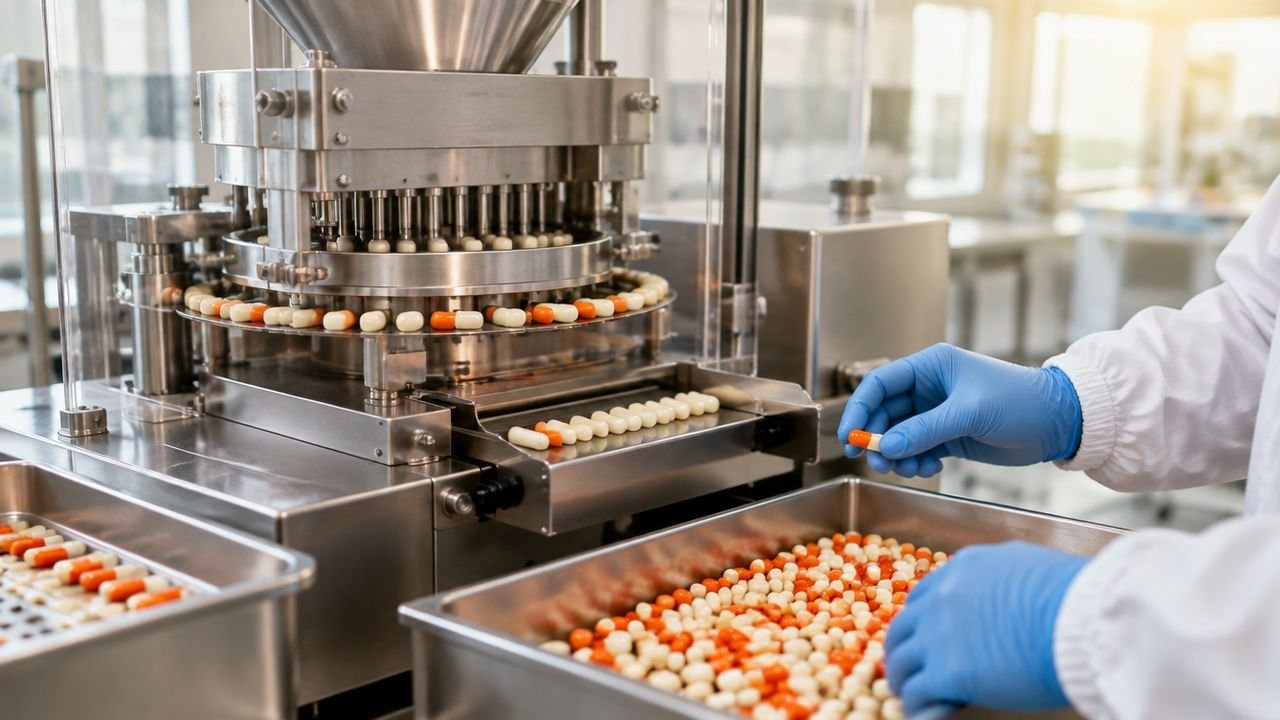
Third party nutraceutical manufacturing lets you sell supplements under your own brand without owning a factory. You own the name, the label and the market. A contract manufacturer runs formulation, production, testing and packing. Almost every new supplement brand in India starts this way, and many established ones never stop, because a good partner network covers more dosage formats than any single plant can.
This guide walks through how the model actually works: who owns what, the eight steps from first enquiry to dispatch, what belongs in the contract, and how to judge a partner before you commit to a first batch.
Third party, private label, white label: one family
The terms overlap. Third party manufacturing describes the arrangement: someone else makes your product. Private label usually means a formula built or adapted for your brand. White label means a ready formula with your label on it. All three run on the same mechanics. If you are deciding between them, read Private Label vs White Label vs Custom Manufacturing.
Who owns what
- The brand owner owns the brand name, trademark, artwork, customer relationships and, under a fair contract, the final formula specification.
- The manufacturer owns its process know how, equipment and facility approvals, and is accountable for making each batch to the agreed specification.
- The label names both: the brand owner as marketer and the manufacturing site as maker, each with its own licence number.
The eight steps from enquiry to dispatch
- Brief. Product, dosage form, target dose, the markets you will sell in and your first order volume. A one page brief is enough.
- Formulation and costing. The manufacturer builds a formula on suitable actives and returns a costed quote. At Insignis this lands within two business days.
- Specification sign off. You approve a written spec: actives and their grades, excipients, fill weight, capsule or tablet size, flavour and pack format.
- Samples. Physical samples where the format needs taste or texture approval, such as gummies, powders and stick packs.
- Artwork and label. Label copy is checked against the rules of each destination market before print.
- Raw material sourcing. Every active arrives with its supplier certificate, and branded actives arrive with documentation that ties the material to the trademark you print.
- Production and batch testing. The batch is made, then tested for identity, potency, heavy metals and microbial limits. A Certificate of Analysis is issued for that exact lot.
- Packing and dispatch. Finished goods ship to your warehouse, a marketplace fulfilment centre or an export consignee with the paperwork that market needs.
What the contract must cover
- Formula ownership and confidentiality, in writing.
- The agreed specification, attached as a schedule.
- A Certificate of Analysis on every batch, not on a sample of batches.
- MOQ, unit price, and how long the price holds.
- Lead time from approved artwork to dispatch.
- Shelf life commitment and the stability basis behind it.
- Retention samples and how batch complaints are investigated.
- What happens when a batch fails specification: rework, replacement or credit.
How to judge a partner before the first batch
Look for facility approvals such as WHO GMP, FSSAI and ISO 22000 or FSSC 22000, and ask to see them. Ask for a sample COA and check that it reports identity, potency and purity against limits. Ask how branded actives are sourced and documented. Ask for finished products you can buy today. Our 12 point checklist for choosing a contract manufacturer covers each question in detail, and our guide to MOQ and cost explains what drives the price.
How Insignis runs it
Insignis is asset light by design. We own formulation, sourcing, quality control and programme management, and we produce across an audited WHO GMP partner network. That gives one accountable partner across eight dosage formats: capsules, tablets, softgels, gummies, powders, liquids, sachets and oral strips. There are 44 ready to brand formulas to start from, branded clinical actives to build on, a COA with every batch, and supply into eight markets. See the full product range or request a quote.
Key takeaways
- Third party manufacturing lets you own the brand while a partner owns the factory work. Private label and white label are variations of the same model.
- Insist on a written specification and a Certificate of Analysis for every batch. Both belong in the contract.
- Judge a partner on documents you can see: facility approvals, a sample COA and finished products already in the market.
Questions, answered
Is third party manufacturing legal for supplements in India?+
Yes. It is the standard model for nutraceutical brands in India. The brand owner and the manufacturing site each hold their own licence, and both appear on the label.
Who owns the formula in third party manufacturing?+
That depends on the contract. Agree in writing that the final specification belongs to your brand before the first batch.
How long does a first batch take?+
Timelines depend on dosage form and raw material availability. The fastest route is a ready formula in a common format; custom formulas add formulation and sample time.
Bring us your brand. We bring the proof.
A costed quote within two business days, and a Certificate of Analysis with every batch.
Trademarks are the property of their owners.