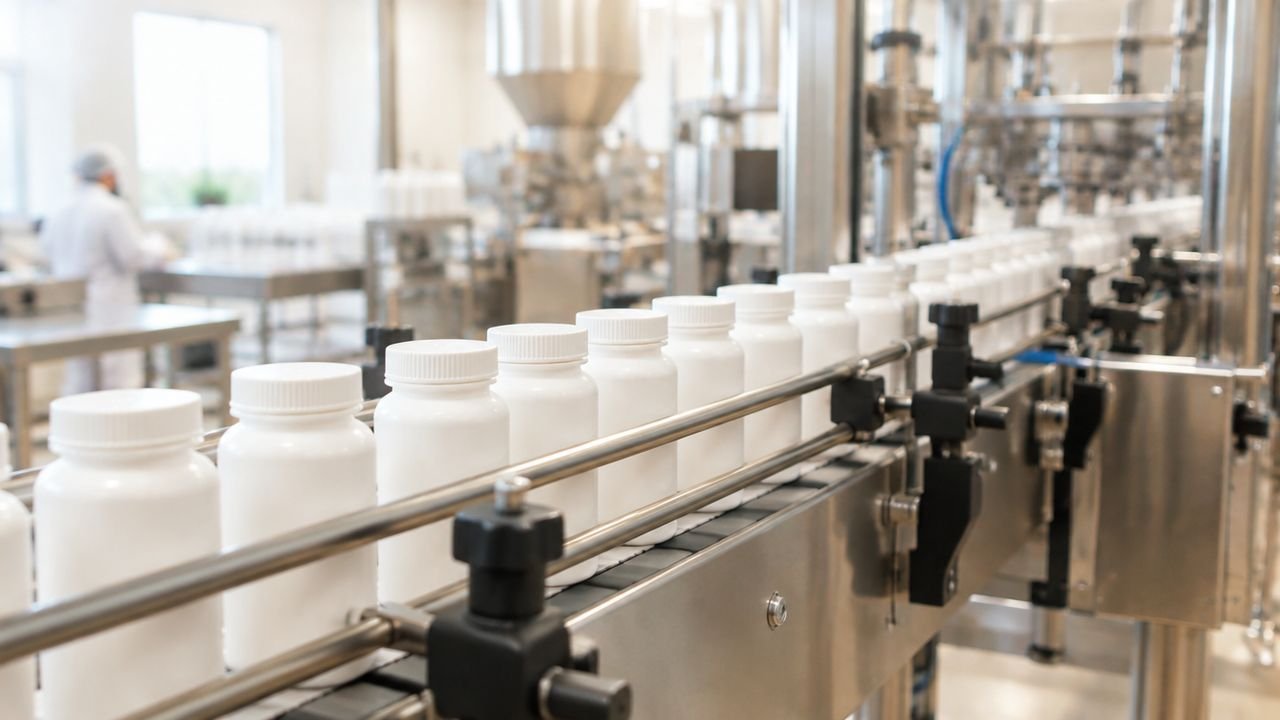
Ask three contract manufacturers for a quote and you will get three different numbers with no explanation of why. One says the minimum order is 1,000 bottles. Another says 10,000. A third quotes a per-capsule price that looks cheap until you read the fine print on the actives. Supplement manufacturing MOQ and cost in India is not one number — it is a stack of decisions, and each one moves the floor.
This guide pulls the stack apart. What sets the minimum order quantity (MOQ). What drives the per-unit cost. The realistic ranges to budget for, the levers you actually control, and how to get a quote you can trust instead of a round figure designed to win your business. No hype, no 'lowest MOQ in India' claims without the context that makes them mean anything.
It is written for the founder launching on Amazon India or a quick-commerce shelf, counting rupees, trying to work out whether the first run costs ₹80,000 or ₹8 lakh. The honest answer: it depends on five things, and you can see all five coming.
The five things that move MOQ and cost
Every quote is built from the same five inputs: the dosage form, the actives inside it, the packaging around it, the testing on top, and the size of the run. Change any one and both the MOQ and the per-unit price move — sometimes a little, sometimes by a multiple.
MOQ and per-unit cost pull in opposite directions, and that tension is the whole game. A manufacturer sets a minimum because a batch carries fixed costs — line setup, cleaning, a testing panel, raw-material minimums from suppliers — that have to spread across the units produced. Small run, high cost per unit. Large run, low cost per unit, but more cash locked in inventory and more risk if the product sits.
So 'low MOQ' is never free. It usually means a higher price per bottle, a limited menu of ready formulas, or stock packaging you cannot fully change. That is not a trap — it is a fair trade, and it is often the right call for a first launch. You just want to see the trade clearly instead of discovering it on the invoice.
Dosage form sets the floor
The format you choose decides the lowest MOQ you can get, because each form runs on a different kind of line. Capsules, tablets, and powders are the most flexible — the equipment handles small batches without much waste, so minimums can often start in the low thousands of units per SKU. For a first-time brand, a two-piece capsule is usually the cheapest, fastest way to get to market.
Gummies, softgels, and liquids usually sit higher. A gummy depositing line and a softgel encapsulation line are batch-sized: the machine wants a minimum volume of mix or gel to run cleanly, so MOQs commonly start around 5,000 units and often go well beyond that, and custom tooling (moulds, for example) adds cost. They look premium on a shelf and they photograph well for Amazon, but they ask for a bigger first commitment. Sachets, stick-packs, and oral strips each have their own economics again.
There is no 'best' format — only the one that fits your actives, your price point, and your cash. An oil-based or fat-soluble ingredient often suits a softgel; a 2-gram daily dose of a botanical extract will not fit in two capsules (a size 00 capsule holds well under a gram of most extract powders) and wants a powder or a stick-pack. Pick the form the product needs, then budget the MOQ that comes with it.
The actives: where the real money is
For most supplements the actives are the single biggest cost swing, and the choice between a generic ingredient and a branded, clinically studied one can multiply the raw-material bill. Generic ashwagandha extract is inexpensive. KSM-66® — a specific full-spectrum, root-only extract with its own human trials — typically costs significantly more per kilo. The same gap shows up between generic curcumin and Curcumin C3 Complex®, between a commodity berberine and HIMABERB®, between ferrous salts and the chelated iron Ferrochel®, between a house probiotic blend and named strains like HOWARU®, LGG®, or BB-12®.
You are paying for two things with a branded active: a documented identity and dose that matches the published studies, and a claim you can actually stand behind. In India, a health supplement or nutraceutical label can carry structure-function and general well-being claims — 'supports', 'aids' — backed by accepted science, but never a claim that it treats, cures, mitigates, or prevents a disease. That 'supports' line is far easier to defend when the ingredient, the dose, and the form match a real trial rather than a generic lookalike bought on price.
This is also the lever with the most room in it. Dropping from a branded active to a generic can cut your per-unit cost sharply; it can also cut the reason a customer picks you over the cheapest listing on Amazon. Decide what the brand is for before you decide what goes in the capsule.
Packaging, testing, and run size
Packaging is the cost founders underestimate. The bottle, cap, induction seal, label, and carton can rival the formula cost on a low-priced SKU, and each custom component carries its own supplier MOQ — custom-printed bottles or cartons often have minimums far above your first production run, which is why stock packaging with a printed label is the usual starting point. Quick-commerce and Amazon India add their own realities: shelf-ready cartons, MRP and the other Legal Metrology declarations, the barcodes marketplaces require, and tamper-evidence all live in this line.
Testing is not optional and it is not where you cut. Every batch should be checked for identity (is the ingredient what the label says), potency (is the dose what the label says), and purity (heavy metals, commonly by ICP-MS, plus microbial limits and other contaminants against the applicable FSSAI limits). That panel has a fixed cost per batch, which is exactly why a small run carries a higher cost per bottle — the same test spreads across fewer units. The output you want is a Certificate of Analysis (COA) for the lot, the document that shows the results for that batch.
Run size ties it together. The larger the batch, the lower the fixed costs per unit — testing, setup, raw-material minimums all dilute. But a bigger run means more cash committed and more exposure if the product does not move. The craft is matching run size to a realistic sell-through, not to the lowest per-unit price a spreadsheet can produce.
Typical ranges — and why 'low MOQ' claims vary
Treat any published number as illustrative, because the five inputs above reset it every time. As a rough frame for India: capsules and tablets can often start in the low thousands of units per SKU; gummies, softgels, and liquids more commonly from around 5,000 upward. A first run with stock packaging and a ready formula can land in the low lakhs of rupees all-in; the same SKU with branded actives, custom packaging, and a larger batch can be several times that. Per-bottle cost is usually dominated by the actives, then packaging, then the amortised testing and setup.
This is why 'low MOQ' claims differ so much between manufacturers. A low minimum on a stock, pre-developed formula in stock packaging is genuinely easy to offer — the development and sourcing are already done. A low minimum on a fully custom formula with branded actives and bespoke packaging is a different, far harder promise, and a quote that offers it cheaply is usually quietly substituting a stock formula, a generic active, or stock packaging to get there.
None of that is dishonest on its own. The problem is only when the substitution is not stated. When you compare quotes, compare like for like: same form, same actives by brand and dose, same pack count, same packaging status, same test panel. Two 'low MOQ' numbers can describe completely different products.
How to get a real quote, not a guess
A manufacturer can only cost what you specify, so the quality of your quote depends on the quality of your brief. Give them: the dosage form; the actives you want, named by brand where it matters (KSM-66® ashwagandha, not 'ashwagandha'), with target doses; the bottle or pack count per unit; stock versus custom packaging; the quantity you want to run; your target market; and whether you are building a new formula or starting from a ready one.
Those inputs turn a round number into a costed one. Ask for a line-item breakdown — actives, excipients, capsule or base, packaging, testing, and the per-unit cost at the run size you asked for — plus the MOQ, the lead time, and what changes if you move the quantity up or down. If a quote arrives as a single price with no breakdown, ask for the lines. A manufacturer who can show the stack is one who built the quote from your product rather than from a template.
Check the compliance fit too. For the Indian market, the manufacturing site needs a central FSSAI licence covering health supplements and nutraceuticals (FSSAI moved these manufacturers to central licensing in 2021), you need your own FSSAI licence as the brand owner, and the label and claims have to meet the 2022 health-supplement and nutraceutical regulations — staying on the 'supports' and 'aids' side of the line. For export — the Gulf, the US, Southeast Asia — the testing and documentation requirements shift again, and that belongs in the conversation before the first batch, not after.
Where Insignis fits
Insignis Bioscience is a private-label and custom supplement contract manufacturer (CDMO) in India, running asset-light across an audited WHO-GMP partner network and serving eight markets — India, the UAE, Saudi Arabia, the USA, Sri Lanka, Singapore, Nepal, and Myanmar. We work across 8 dosage formats, offer 44+ ready-to-brand formulas, and use branded actives including KSM-66®, Curcumin C3 Complex®, HIMABERB®, Ferrochel®, K2VITAL®, and the HOWARU®/LGG®/BB-12® probiotics — so your label can name the ingredient behind the claim.
On the two things this guide is about — MOQ and cost — we keep it concrete. Low MOQs, so a first launch does not demand a warehouse of inventory. A costed quote in two business days, not a round number. Every batch is tested and comes with a Certificate of Analysis for the lot, so the per-unit price you pay buys a product you can stand behind.
If you have a product in mind, send the brief — form, actives, doses, quantity, market — and you will get a costed quote back, not a guess. That is the honest version of 'low MOQ': you see the trade, you see the numbers, and you decide what your brand is worth building.
Key takeaways
- MOQ and per-unit cost pull against each other: a low minimum almost always means a higher price per bottle, a stock formula, or stock packaging — not a free lunch.
- The actives are usually the biggest cost swing. A branded, clinically studied ingredient like KSM-66 ashwagandha or Curcumin C3 Complex typically costs significantly more than its generic equivalent — and it is also what makes a claim defensible.
- Dosage form sets the floor: capsules, tablets and powders can often start in the low thousands of units; gummies, softgels and liquids usually run higher because the lines are batch-sized.
- A real quote needs real inputs — form, strength, actives by brand, bottle count, pack size, label status and target market. Give a manufacturer those and you get a costed number, not a round one.
Clinical figures cited refer to published human studies on the specific branded active named, at the dose studied — not to any finished product, and not as a claim to diagnose, treat, cure, or prevent any disease. Trademarks are the property of their owners.