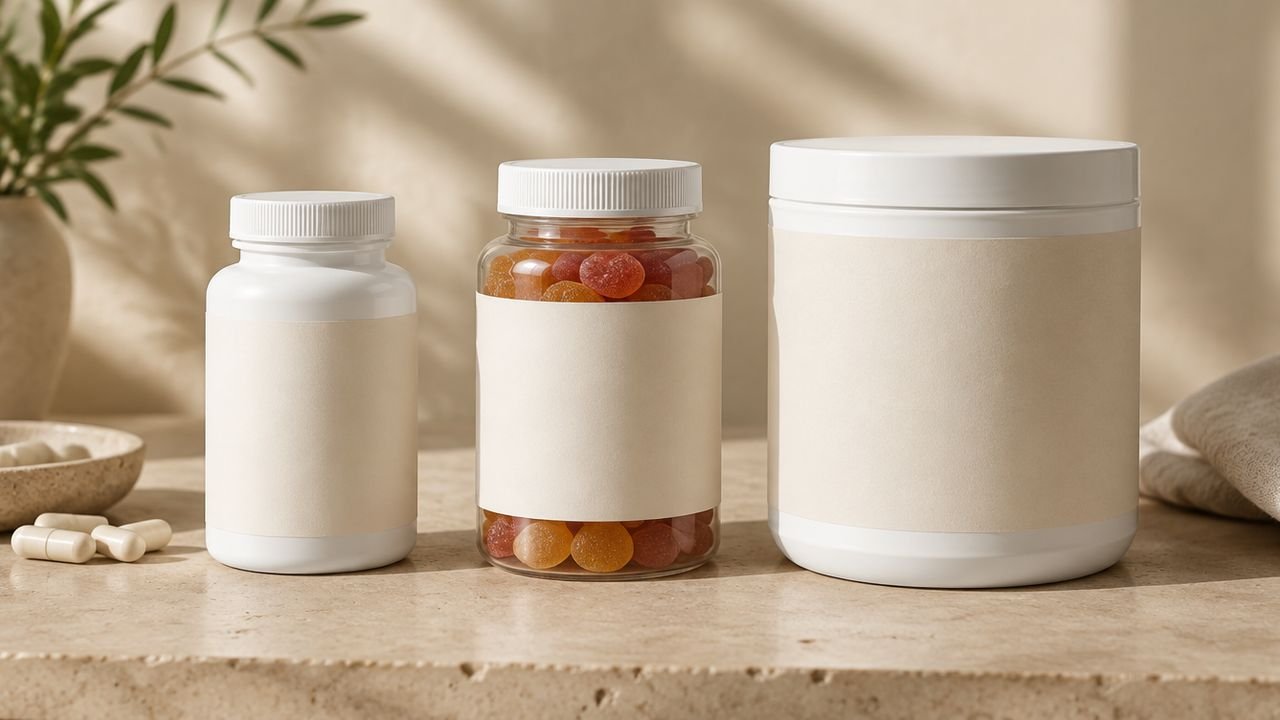
You have a product idea, a brand name, and a plan to sell on Amazon India or a quick-commerce shelf. The next decision shapes your cost, your launch date, and whether a competitor can sell the exact same capsule under a different label next month. That decision is the manufacturing model. For most founders it comes down to private label vs white label supplements, with a third option — full custom manufacturing — sitting behind both.
The three terms get used loosely, and manufacturers do not all draw the lines the same way. That vagueness costs founders money. Pick white label when you needed custom, and you launch a me-too product. Pick custom when white label would have done, and you burn months and lakhs you did not need to spend.
This guide defines each model in plain terms, then compares them on the five things that actually decide it: speed to shelf, cost, minimum order quantity (MOQ), how much you can differentiate, and who owns the formula. It is written for an Indian supplement founder — FSSAI, rupees, Amazon India, quick-commerce lead times and all. Insignis Bioscience works in private label and custom manufacturing, so where it earns a mention it gets one, but this is a buyer's guide first.
White label supplements: fastest to shelf, least yours
A white-label supplement is a finished product the manufacturer already makes and sells to many brands. The formula, the capsule, the dose — all fixed. You add your label and your carton. That is the whole transaction. A whey blend, a multivitamin, a biotin gummy sitting in a catalog is white label the moment five different brands can buy the identical SKU and print different names on it.
The appeal is speed and price. There is no formulation work, so order-to-stock is typically a matter of weeks rather than months, depending on the manufacturer's schedule and your packaging. MOQs are usually the lowest of the three models — often a few hundred to a few thousand units per SKU — so your first purchase order stays small. Per-unit cost tends to be lowest too, because the manufacturer is running a product it already tooled up for.
The cost is differentiation and ownership. You own the brand name and the artwork; you do not own the formula. A competitor can list the same capsule on Amazon India the same week. You cannot claim a unique dose or a specific branded active unless the stock formula already carries it. White label fits a founder testing a category, filling a gap in an existing range, or launching fast on a tight budget — not one trying to build a defensible product.
Private label supplements: your brand, a catalog base
Private label is the term that causes the most confusion, because many people use it to mean the same thing as white label. In practice a useful line separates them. White label is off-the-shelf and identical across buyers. Private label is a base formula from the manufacturer's catalog, produced for your brand, with room to adjust the parts that make it feel like yours — label and packaging always, and often flavour, colour, capsule size, bottle count, or a dose tweak within the formula's limits.
So the formula still comes from the manufacturer's library rather than a blank page, but the finished product is more yours than a white-label SKU. You might take a base turmeric formula and specify Curcumin C3 Complex® as the active, a 60-count bottle, and a specific strength. The base IP usually stays with the manufacturer — ask whether the base is exclusive to you; the brand, the presentation, and the market position are yours.
Speed and MOQ sit in the middle. Expect several weeks once the base and customisations are locked — typically longer than pure white label — with MOQs modestly higher because the run is configured for you. This is the common starting point for a serious Indian brand: enough control to differentiate on actives, dose, and format, without the cost and timeline of building a formula from scratch. Insignis lists 44+ ready-to-brand formulas and works across 8 dosage formats — exactly these kinds of bases.
Custom manufacturing: your formula, built from scratch
Custom — also called full-service contract manufacturing or full formulation — means the formula is developed to your specification. You choose the actives, the doses, the ratios, the delivery format, the release profile. The manufacturer's R&D and regulatory teams turn that into a producible, stable, compliant product. The output is a formula that does not exist anywhere else.
This is the slowest and most expensive route, and the MOQs are usually the highest. Formulation, stability work, and first production commonly take a few months before stock reaches you, and the quantities needed to make a bespoke run economic are larger. You are paying for development, not just filling.
What you get back is a product nobody else can sell and, usually, formula ownership — but confirm that in writing, because IP terms vary by contract. Custom earns its cost when your differentiation is the formula itself: a clinically-dosed stack, a novel combination, a specific release system, a claim you intend to defend. If your edge is brand, price, or distribution rather than the formula, custom is money spent ahead of need.
Side by side: speed, cost, MOQ, differentiation, ownership
Speed to shelf: white label is fastest (typically weeks), private label sits in the middle (somewhat longer once specs are locked), custom is slowest (often a few months including formulation and stability). Exact timings vary by manufacturer and format, so get them in writing. If a quick-commerce buyer or an Amazon India launch window is forcing a date, this line often decides it on its own.
Cost and MOQ move together, and both rise as you move from white to private to custom. White label generally has the lowest per-unit price and the smallest minimum order, so it protects cash on a first run. Custom has the highest of both, because you are funding development and a larger batch. Private label lands between the two. Match the model to the capital you can tie up in inventory, not to ambition.
Differentiation and ownership are the trade you make for that speed and cost. White label gives you a brand on a shared product and no formula ownership. Private label gives you real control over actives, dose, format, and presentation, with the base IP usually staying with the manufacturer. Custom gives you a unique formula and usually its ownership. The honest rule: the faster and cheaper the model, the less of the product is actually yours.
How to pick: a decision path for an Indian founder
Start with your edge. If you will win on brand, content, pricing, or distribution, white or private label is right — spend your money on marketing and listings, not formulation. If you will win on the product itself — a specific stack, a dose you can stand behind, a format competitors do not offer — custom is where the money belongs. Most first-time Indian founders win on brand and distribution first, which is why private label is the common, sensible starting point.
Then layer in the practical constraints. FSSAI applies whichever model you choose: a brand that has a third party manufacture its product generally needs its own FSSAI licence as a relabeller (with an e-commerce endorsement if you sell online), health-supplement manufacturing sits with FSSAI's Central Licensing Authority, and the product must meet the FSS (Health Supplements, Nutraceuticals…) Regulations, 2016 — which bar claims to prevent, treat, or cure disease. Check your working capital against MOQ in rupees, not units: a low per-unit price still becomes a large cheque at, say, a 5,000-unit minimum. Check lead time against your channel — quick-commerce and Amazon India reward consistent stock, so a model you cannot reorder in time will cost you rank and buy-box.
A reasonable path for most: start private label to get a differentiated product to shelf at a sane cost and MOQ, prove the demand on Amazon India or quick-commerce, then move your hero SKU to custom once volume justifies owning a unique formula. You do not have to pick one model for life — you pick one per SKU, per stage.
What to check before you sign, whichever model you pick
The manufacturing model decides differentiation. It does not, by itself, decide quality. A white-label product from a disciplined manufacturer can be more trustworthy than a custom formula from a sloppy one. So vet the manufacturer on proof, not promises, in all three cases.
Ask for the receipts. Is the facility WHO-GMP certified and FSSAI licensed? Does the manufacturer test every batch for identity, potency, and purity — and will they ship a Certificate of Analysis (COA) per lot, not a generic spec sheet? Are the actives branded and clinically studied — KSM-66® ashwagandha, Curcumin C3 Complex®, HIMABERB® berberine, Ferrochel® iron bisglycinate, K2VITAL® vitamin K2, HOWARU®/LGG®/BB-12® probiotics — so you know exactly what is in the capsule and can say so on the label? A manufacturer who answers these quickly is one you can build on.
Also confirm the commercial basics in writing: MOQ per SKU, lead time for first run and reorders, which markets they can produce and document for if you plan to export, and — for custom — who owns the formula. Get a costed quote before you commit, and treat a slow or vague quote as data about how the relationship will run.
Where Insignis fits
Insignis Bioscience is a private-label and custom supplement contract manufacturer (CDMO) in India, so a SKU can start on a ready-to-brand base and later move to a custom formula without changing partners. It is asset-light, producing across an audited WHO-GMP partner network, with low MOQs for founders who want to keep a first run small.
The proof side is built in. Insignis works with branded actives — KSM-66®, Curcumin C3 Complex®, HIMABERB®, Ferrochel®, K2VITAL®, and HOWARU®/LGG®/BB-12® — tests every batch, and ships a Certificate of Analysis per lot, so what the label says is what the COA shows. There are 44+ ready-to-brand formulas and 8 dosage formats to start from, and Insignis serves 8 markets: India, UAE, Saudi Arabia, USA, Sri Lanka, Singapore, Nepal, and Myanmar.
If you want to size the decision against real numbers, the fastest next step is a costed quote — Insignis returns one in two business days. That is enough to compare per-unit cost, MOQ in rupees, and lead time across private label and custom for your specific SKU, and to decide which model your first run actually needs.
Key takeaways
- White label is fastest and cheapest but identical across buyers with no formula ownership; private label lets you customise a catalog base under your brand; custom builds a unique formula you usually own, at the highest cost, MOQ, and lead time.
- Match the model to your edge: win on brand, price, or distribution and pick white or private label; win on the product itself and pay for custom. Most Indian founders start private label and move a hero SKU to custom once volume justifies it.
- Pick per SKU against hard constraints, not ambition — your own FSSAI licence (typically as a relabeller) and the 2016 health-supplement rules against prevent/treat/cure claims apply to all three, and MOQ in rupees plus reorder lead time decide whether you can hold Amazon India and quick-commerce shelf.
- The model sets differentiation, not quality: vet every manufacturer on WHO-GMP, FSSAI, branded clinically studied actives, per-batch testing, and a COA per lot before you sign.
Clinical figures cited refer to published human studies on the specific branded active named, at the dose studied — not to any finished product, and not as a claim to diagnose, treat, cure, or prevent any disease. Trademarks are the property of their owners.