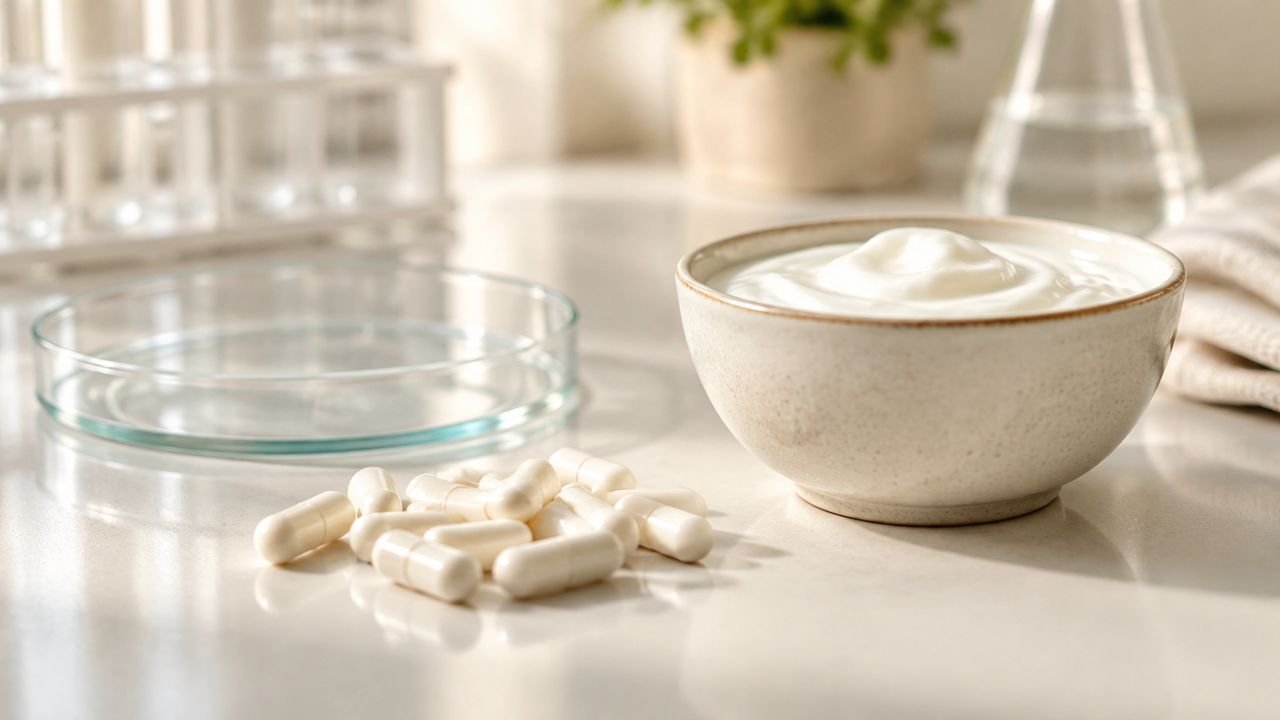
A probiotic is the one supplement where the label number can quietly fall after the batch leaves the factory. Live cultures lose count with heat, moisture and time. A good private label probiotic is designed around that fact from the first spec.
The strain is the product
Clinical evidence attaches to a specific strain, not to a species. Lactobacillus rhamnosus GG and another L. rhamnosus are different ingredients with different research behind them. That is why we build on named, documented strains such as LGG®, BB-12®, HN001, NCFM®, LA-5®, L. casei 431®, Bacillus coagulans Unique IS-2®, Bacillus clausii UBBC-07 and Saccharomyces boulardii. The same principle applies across actives; see the trial belongs to the brand, not the botanical.
CFU at expiry, not at manufacture
A count printed at manufacture tells a customer little. The useful promise is the CFU guaranteed until the expiry date. Manufacturers reach it with an overage: more culture goes in at production so the count still meets the label at the end of shelf life. The size of the overage depends on the strain, the format and the storage conditions, and it is one of the biggest cost drivers in the formula.
Formats that protect live cultures
| Format | Typical use | Notes |
|---|---|---|
| Capsules | High count daily probiotics | Our women's formula carries 60 billion CFU per capsule |
| Stick packs | Kids, adults who dislike capsules | Our probiotic sticks carry 10 billion CFU |
| Gummies | Taste led daily habit | Spore forming strains such as B. coagulans survive gummy processing far better |
| Tablets | Lower cost, mass market | Compression heat and pressure limit strain choice |
Moisture and packaging
Water activity is the main enemy of shelf life. Expect low humidity filling, desiccant lined bottles or alu alu blisters, and in some cases nitrogen flushing. Ask your manufacturer what packaging the stability claim is based on, and do not change pack format without rechecking it.
What to test on every batch
- Enumeration: the CFU count against specification.
- Identity of the strains in the blend.
- Microbial contaminants and heavy metals.
- A Certificate of Analysis for that exact lot.
Costing a probiotic
Strain choice, CFU level, overage, format and packaging set the price. Branded strains cost more than generic cultures and carry the research. See our Women's Probiotic 60 Billion CFU and Probiotic Sticks formulas, or request a quote.
Key takeaways
- Evidence belongs to the strain. Name the strain on the label, not only the species.
- Guarantee CFU at expiry; the overage needed to do that is a core cost line.
- Packaging and humidity control decide whether the count survives shelf life.
Questions, answered
Which probiotic strains can Insignis supply?+
Named strains including LGG®, BB-12®, HN001, NCFM®, LA-5®, L. casei 431®, B. coagulans Unique IS-2®, B. clausii UBBC-07 and S. boulardii, alone or blended.
Can probiotics be made as gummies?+
Yes, with spore forming strains such as Bacillus coagulans, which tolerate gummy processing far better than most lactobacilli.
Is CFU guaranteed until expiry?+
Our probiotic specifications are written to the count at expiry, with the overage built into the formula.
Bring us your brand. We bring the proof.
A costed quote within two business days, and a Certificate of Analysis with every batch.
Trademarks are the property of their owners.